
November 24, 2026
Alternatives to Braces for Straightening Teeth in Adults
Compare alternatives to braces for straightening teeth, when clear aligners fit adult cases, and why whitening or veneers solve different problems.
Summary: Clear aligners are the primary alternative to traditional braces for adults needing teeth movement, offering a discreet and removable option. Cosmetic dentistry, including veneers and whitening, addresses appearance rather than alignment, while restorative dentistry is suitable for structural issues. Each option serves different needs, and a consultation helps determine the best approach based on individual goals and dental conditions.
A photo gets passed around after dinner, and someone says the smile looks great except for the one tooth that keeps catching the light. The comment lands because the tooth has bothered you for years, but the thought of metal brackets in meetings, family photos, or daily life still feels like too much.
A dentist mentions alignment, and the first picture that comes to mind is traditional braces. Adult teeth, however, raise a more specific question: whether the problem is tooth position, tooth shape, tooth color, old dental work, or a combination that needs more than one kind of care.
The best alternative is not the least visible option. The best alternative is the one that matches the job: clear aligners move teeth, cosmetic dentistry changes how teeth look, whitening changes color, and restorative work repairs teeth that cannot be solved by movement alone.
Which alternatives to braces for straightening teeth are real options?
Clear aligners are the main alternative to traditional braces when adult teeth need to move. Aligner treatment uses a sequence of removable trays planned by a dental or orthodontic professional, and the case selection matters more than the brand name on the box.
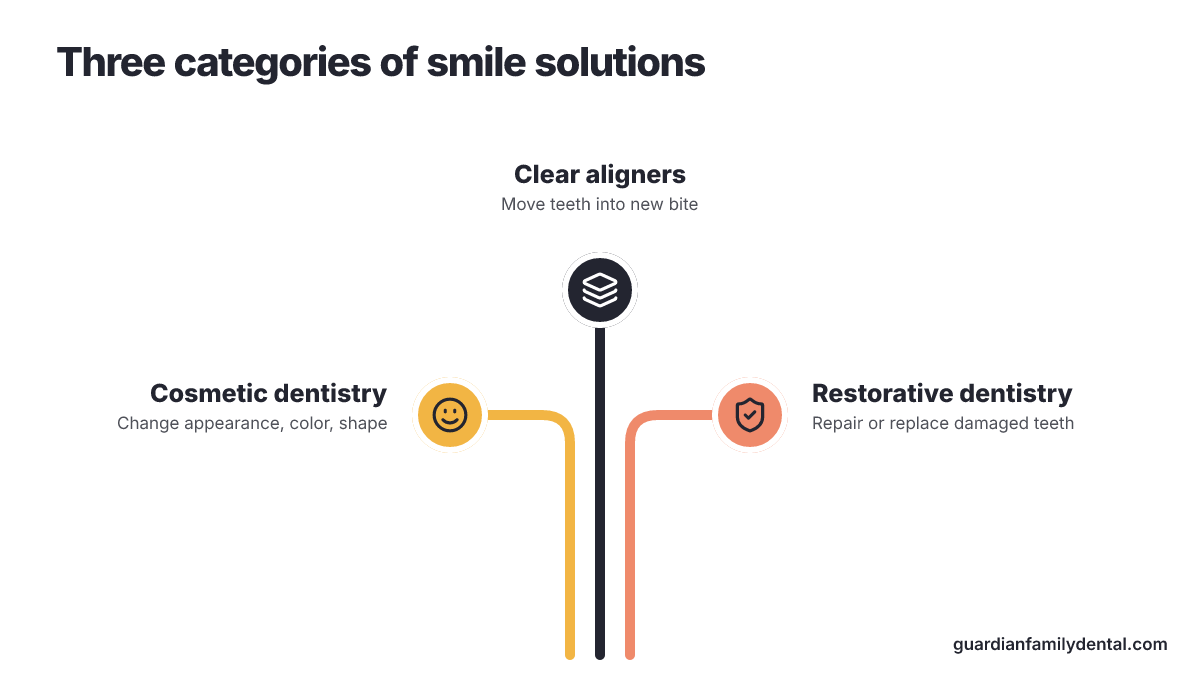
Cosmetic dentistry is a different category because veneers, smile makeovers, and whitening do not move teeth into a new bite. Cosmetic care changes the visible surface, color, proportions, or symmetry of the smile, which makes it useful when the concern is appearance rather than tooth position.
Restorative dentistry belongs in the conversation when the tooth that looks crooked is also cracked, heavily filled, worn down, missing, or part of a larger chewing problem. A same-day crown, implant consultation, or denture discussion is not a braces substitute, but it may be the correct route when the real problem is tooth structure rather than alignment.
Adult patients often arrive with mixed goals: one tooth rotated, several teeth crowded, a darker shade before a wedding, and anxiety about being pushed into a long treatment plan. A useful consultation separates those goals before giving a recommendation, because straightening a tooth and making a tooth look straighter are not the same promise.
Guardian Family Dental has 4.9 stars from 668 reviews, and patient comments repeatedly mention feeling listened to, having treatment options explained, and being treated gently. That matters for adult alignment decisions because a patient who feels rushed is more likely to choose the quickest-looking option before understanding what it can and cannot fix.
A careful visit should leave the patient knowing whether the goal is movement, color, tooth shape, or repair before any treatment is scheduled.
Clear aligners: the main non-brace treatment for adults
Clear aligners work best for adults when the teeth need controlled, limited movement and the patient will wear the trays as directed. The evidence backs aligners for simpler cases, but it does not back treating every adult bite problem as an aligner case.
The Angle Orthodontist's 2025 systematic review found that clear aligners and fixed appliances both worked well for simple non-extraction cases across 21 randomized trials involving 970 participants, while the review also described the overall evidence quality as low. That finding leaves aligners as a real treatment option, not a universal replacement for braces.
International Orthodontics' 2026 review of 12 adult anterior-tooth studies found limited evidence that fixed appliances offered better control of tooth rotation and torque. Adults whose main problem is a difficult rotation or root-positioning issue should not treat aligners as the automatic discreet choice, because the most invisible option may be the weaker tool for that movement.
Clear aligner success depends on habits that braces do not require in the same way. Trays come out for meals and cleaning, which adults often like, but removable treatment creates a daily compliance problem that fixed brackets avoid. Some people handle that without trouble. Others do not, and the mouth does not care about good intentions.
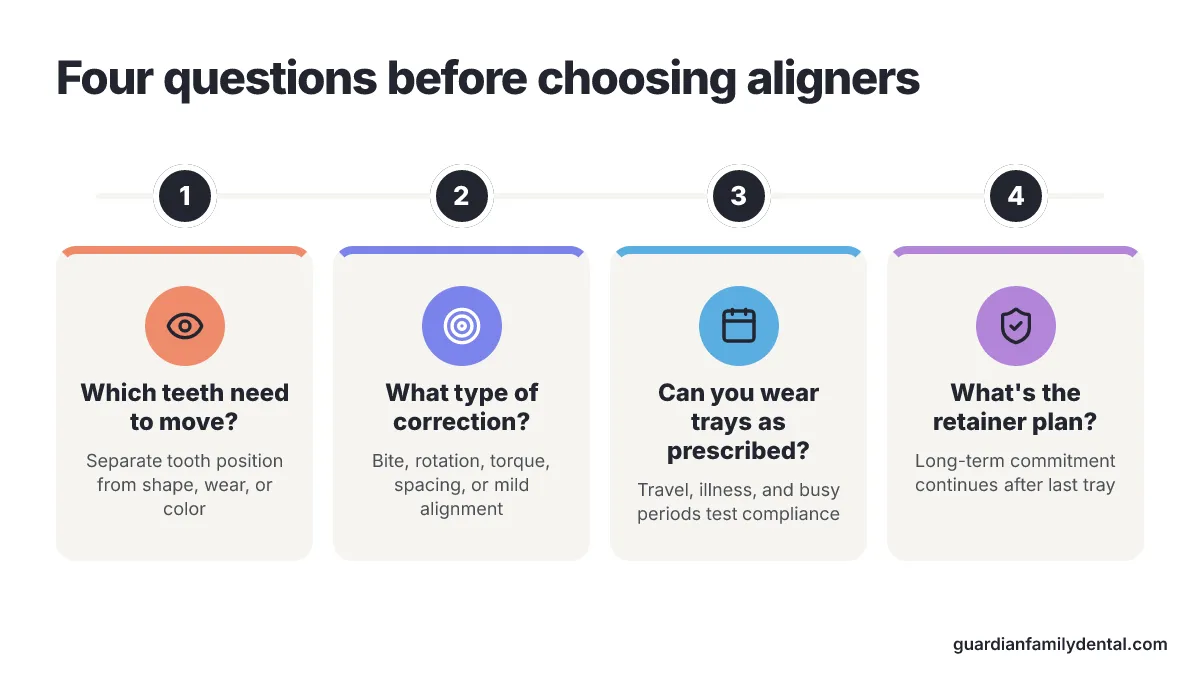
Adult patients should ask four questions before choosing aligners:
- Which teeth need to move, and which teeth only look uneven because of shape, wear, or color?
- Does the plan involve bite correction, rotation, torque, spacing, crowding, or only mild front-tooth alignment?
- What happens if trays are not worn as prescribed during travel, illness, or busy work periods?
- What retainer plan protects the result after active treatment ends?
Retention is not a small afterthought after adult alignment. NHS England's 2019 orthodontic retainer guidance says orthodontists advise continued retainer use for as long as patients want to keep teeth straight, which means the long-term commitment continues after the last tray.
Adult patients who want a low-maintenance solution need to hear that point early. A short aligner plan followed by neglected retainers is not a stable alternative to braces, because teeth can shift after any orthodontic movement.
When cosmetic dentistry is a better answer than tooth movement
Cosmetic dentistry is the better answer when the adult patient dislikes the way teeth look but the bite does not need meaningful correction. A tooth may appear crooked because one edge is chipped, one tooth is narrow, one shade is darker, or an old restoration breaks the visual line of the smile.
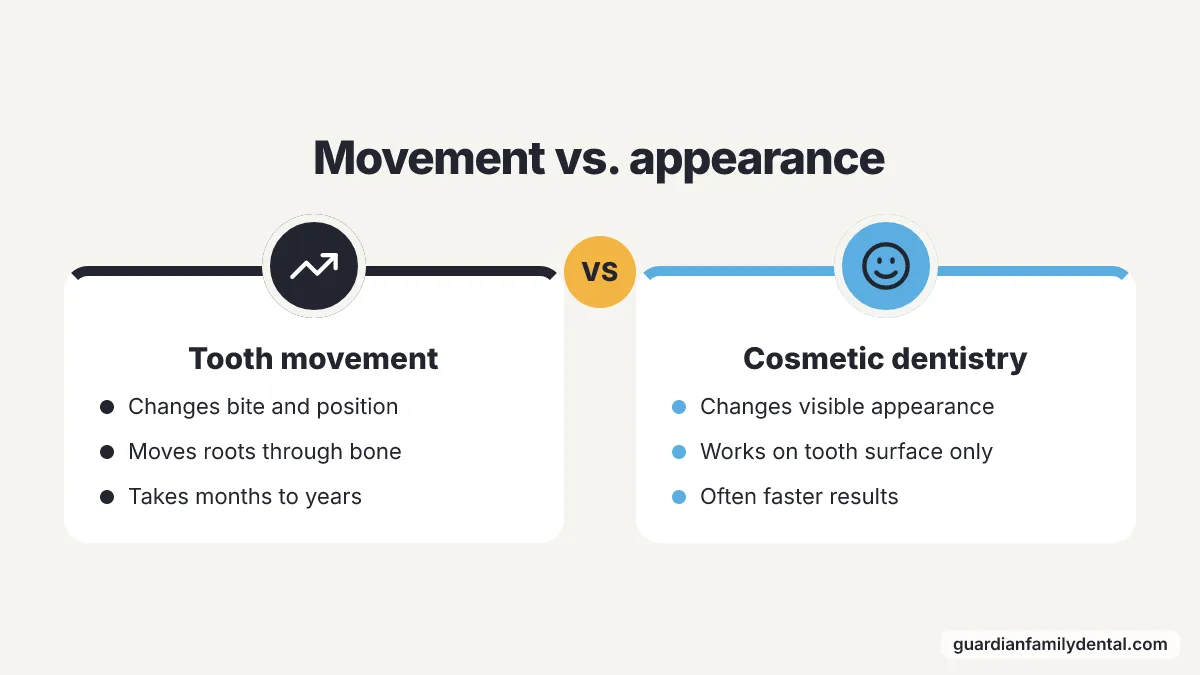
Veneers and smile makeovers address the visible face of teeth rather than moving the roots through bone. That distinction matters for adults who want a faster cosmetic change but do not have a bite problem that requires orthodontics.
Zoom! Teeth Whitening belongs in the alignment conversation only when color is driving the dissatisfaction. Whiter teeth do not become straighter, but a brighter shade before an event can change how noticeable minor unevenness feels in photos.
Patients who are asking whether professional whitening is safe can also read the practice's explanation of professional teeth whitening safety before making a cosmetic decision.
CEREC same-day crowns belong in a separate category because a crown repairs and covers a damaged tooth rather than straightening an otherwise healthy one. Adults sometimes describe a broken or heavily restored tooth as "crooked," when the better dental question is whether the tooth needs restoration before any cosmetic or alignment work makes sense. Dental implants, dentures and partials, and emergency dentistry may enter the plan when adult teeth are missing, painful, or not stable enough for cosmetic-only thinking. A patient with dental pain should not begin with whitening or veneers, because comfort and diagnosis come before appearance.
The practical test is simple: movement is for position, cosmetic dentistry is for appearance, and restorative care is for damaged or missing teeth. A consultation that starts with that separation gives the patient a clearer decision than a menu of smile services with no explanation.
What changed in clear aligner planning and safety?
Clear aligner technology is moving toward better visualization, but a simulation is still not a guarantee of the final smile. Adult patients should welcome better planning tools while asking who is supervising the treatment and what happens when teeth do not move as predicted.
Align Technology announced in July 2026 that Invisalign planning and visualization updates would help doctors show potential smile and facial changes, while the company described the images as planning aids rather than promised outcomes in its planning and visualization updates. A preview can make a consultation easier to understand, but the biological response of teeth and bone still has to be monitored.
The FDA published a clear-aligner patient resource in September 2026 covering benefits, risks, and professional supervision in its clear-aligner patient information. That federal resource is useful because adult patients are exposed to advertising that makes aligners look like a consumer product, when tooth movement is still dental treatment.
Solventum announced in September 2026 that an October software release for Clarity aligner planning would add smile simulations and a revised attachment strategy in its Clarity portal software update. Attachment planning matters because attachments are small tooth-colored shapes placed on teeth to help trays grip and guide movement, and fewer or better-planned attachments can affect how treatment feels and looks.
The FDA cleared the SHINING3D clear aligner system for marketing in October 2026 through a clear aligner clearance, but clearance does not mean a system is immediately available in every dental office. Patients should treat FDA clearance as one safety and marketing milestone, not as proof that a particular product is the right treatment for their mouth.
The useful takeaway for adults is not that newer software replaces judgment. The useful takeaway is that better visuals should lead to better questions: what tooth movement is planned, what the limitations are, what attachments are expected, and how the doctor will track progress if the trays stop fitting well.
How should an adult choose the next step?
The first step is a diagnosis visit, not a product choice. Adult alignment decisions require an exam, X-rays when appropriate, a bite evaluation, and a conversation about the patient's tolerance for time, visibility, cost, and maintenance.
A patient who wants alternatives to braces for straightening teeth should arrive with one clear priority. The priority might be avoiding visible brackets, finishing before a specific event, preserving tooth structure, treating pain first, or understanding payment before committing.
A practical appointment should cover five decisions:
- Identify whether the concern is tooth position, color, shape, damage, missing teeth, or several problems at once.
- Ask whether clear aligners would move the teeth predictably in the specific case.
- Ask whether cosmetic dentistry would create the desired look without moving teeth.
- Ask what restorative care is needed before any cosmetic or alignment plan.
- Ask what retention, maintenance, or future replacement the chosen option requires.
Cost clarity belongs in the first conversation because adult patients are often weighing dental care against family budgets.
Dental anxiety belongs in the decision as much as tooth movement does. A patient who avoids care because of discomfort may need shorter visits, more explanation, or sedation options before a longer cosmetic or alignment plan feels manageable.
Spanish-speaking households should ask for explanations in the language that makes treatment decisions easiest to understand. Adult alignment and cosmetic dentistry involve trade-offs, and a patient should not have to agree to tooth movement, whitening, veneers, or restorative treatment through confusion.
A family dental setting also changes the practical side of care. Adults who already bring children for cleanings or routine visits may find it easier to complete a multi-step plan when the practice knows the whole household's schedule, anxiety level, and budget concerns.
What questions should you ask before saying yes?
Adult patients need questions that expose the trade-off in each option. A confident recommendation helps only when the patient knows what the option changes, what it leaves alone, and what care comes after.
Ask, "Will this move my teeth, or will it only change how they look?" That line separates clear aligners from veneers, whitening, crowns, and other cosmetic or restorative choices.
Ask, "What part of my bite makes this case simple or difficult?" The answer matters because the 2026 International Orthodontics review found fixed appliances had better evidence for controlling certain rotation and torque movements in adult anterior teeth.
Ask, "What will I need after treatment to keep the result?" The answer should cover retainers after orthodontic movement, plus later maintenance for cosmetic or restorative work when those options are part of the plan.
Ask, "What happens if the first plan does not track or does not look the way the preview showed?" The answer should cover follow-up visits, refinements, and the limits of any simulation used in planning.
Ask, "Which concern should be treated first if I also want whitening or a smile makeover?" The usual order is diagnosis first, health and stability next, alignment if needed, and cosmetic finishing after the tooth positions and bite are settled.
Adult patients should be wary when a plan skips explanation and jumps straight to a product name. A brand can still fit a good plan, but the diagnosis decides whether clear aligners, cosmetic dentistry, whitening, CEREC same-day crowns, or another route belongs in the sequence.
How to start comparing braces alternatives
Start with a consultation that names the problem before naming the treatment. Bring the photo or concern that started the conversation, then ask whether the issue is movement, color, shape, damage, or missing teeth. The right alternative asks patience from both sides. The dentist has to explain the limits of clear aligners, cosmetic dentistry, whitening, and restorative care, and the patient has to be honest about daily wear, anxiety, budget, and maintenance.
Call (435) 656-8888 or use the online booking option when you are ready to compare the choices with your own teeth, not a generic smile plan.
When should dental problems come before alignment?
Pain, a cracked or broken tooth, a loose tooth, or swelling should be checked by a dentist before any aligner, whitening, or veneer plan begins, because comfort and diagnosis come before appearance. Aligner patients should also have the treating dentist check trays that stop fitting well or cause pain, rather than continuing on their own.
Frequently Asked Questions
What are the alternatives to traditional braces for adults?
Clear aligners are the primary alternative to traditional braces for adults, offering a discreet and removable option for teeth movement. Cosmetic dentistry, such as veneers and whitening, addresses appearance rather than alignment. Restorative dentistry is suitable for structural issues. Each option serves different needs, and a consultation helps determine the best approach based on individual goals and dental conditions.
Are clear aligners effective for all adult teeth alignment issues?
Clear aligners work best for adults when teeth need controlled, limited movement. They are effective for simpler cases but not suitable for every adult bite problem. Difficult rotations or root-positioning issues may require fixed appliances for better control. A consultation can help determine if aligners are the right choice for your specific alignment needs.
When is cosmetic dentistry a better choice than clear aligners?
Cosmetic dentistry is a better choice when the concern is the appearance of teeth rather than their position. Veneers and smile makeovers address the visible surface of teeth, making them suitable for adults who want a faster cosmetic change without needing orthodontic correction. Whitening can also enhance appearance if color is the main concern.
What should adults consider before choosing clear aligners?
Adults should consider which teeth need movement, the type of alignment required, and the importance of wearing trays as prescribed. They should also understand the long-term commitment to retainer use after treatment. A consultation at Guardian Family Dental can help clarify these factors and ensure aligners are the right choice for your needs.
How has clear aligner technology improved recently?
Clear aligner technology has improved with better visualization tools, allowing for more accurate treatment planning. However, these simulations are planning aids rather than guaranteed outcomes. It's important to have professional supervision during treatment to monitor the biological response of teeth and bone. Guardian Family Dental can provide guidance on the latest advancements in aligner technology.
Where to go next
Sources
- The Angle Orthodontist: Effectiveness of Clear Orthodontic Aligners in Correcting Malocclusions
- International Orthodontics: Comparative Effectiveness of Clear Aligners and Fixed Appliances in Orthodontic Movement of the Anterior Teeth in Adults
- NHS England: Orthodontic Retainers Questions and Answers
- FDA: SHINING3D clear aligner system cleared
- Solventum: Clarity aligner planning updates announced
- FDA: New clear-aligner patient resource
Book Your Consultation
Call 435-656-8888 for an appointment or schedule online for an appointment with your St. George, UT dentist.